


[vc_row][vc_column css_animation=”none”][vc_row_inner css=”.vc_custom_1712214253516{padding-top: 89px !important;padding-bottom: 10px !important;}”][vc_column_inner][vc_column_text]
ALUCOBOND® A2
[/vc_column_text][/vc_column_inner][/vc_row_inner][vc_row_inner css=”.vc_custom_1704354769719{padding-bottom: 2em !important;}”][vc_column_inner width=”5/6″][vc_column_text]ACROSS THE WORLD, ALUCOBOND® A2 is the only non-combustible aluminum composite panel used in architecture.
Due to its non-combustible core, this fantastic product meets stringent fire regulations and hugely increases the possibilities when it comes to creative building design.
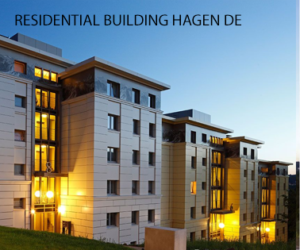
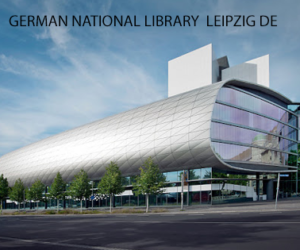
As with all ALUCOBOND® products, ALUCOBOND® A2 allows for simple processing, is impact-resistant, break-proof, and weatherproof – and above all non-combustible.[/vc_column_text][/vc_column_inner][vc_column_inner width=”1/6″][vc_single_image image=”5695″ img_size=”full”][/vc_column_inner][/vc_row_inner][edgtf_accordion content_width=”full-width” skin=”light” custom_class=”product-accordion”][edgtf_accordion_tab title_tag=”h4″ title=”Product Properties”][vc_row_inner][vc_column_inner width=”1/2″][vc_column_text]When it comes to safety, ALUCOBOND® A2 is ideal for high-rise buildings, office complexes, airports, railway and metro projects, shopping malls, hospitals, etc. The superb properties of this material offer an inspiring range of options and solutions for designers – whether your project is a private home, a public building, a corporate headquarters, offices, or a trading or industrial complex. It is also ideal if your organization wants to create a new image through corporate design – whether it is for petrol stations, car showrooms, banks, or supermarkets.[/vc_column_text][/vc_column_inner][vc_column_inner width=”1/2″][vc_single_image image=”5696″ img_size=”full”][/vc_column_inner][/vc_row_inner][vc_column_text]
|
CHARACTERISTICS |
ADVANTAGES |
|---|---|
| Low weight, high rigidity, perfect flatness | Low cost for substructures and fasteners, Smooth handling on the site |
| Large variety of colours | Unlimited planning and design |
| Weatherproof | Supplied ready to install |
| Vibration-damping | No additional sound-damping needed |
| Can easily be folded and bent | Simple processing using conventional tools |
| Large panel sizes, fast installation, pre-fabricated panels | Short construction times, adherence to schedules, low cost |
ALUCOBOND® A2 perfectly adapts to the contours of the building – forming complex, flowing elements. It is the combination of formability, flatness, stability, and weather resistance that characterizes this material.
Due to its composite structure, ALUCOBOND® A2 can take on many different shapes. Think of it as a separate skin wrapping the building’s structure. Its perfect formability does not affect its stability and flatness; the high rigidity of the panel remains.
 [/vc_column_text][vc_column_text]
Lightness meets rigidity
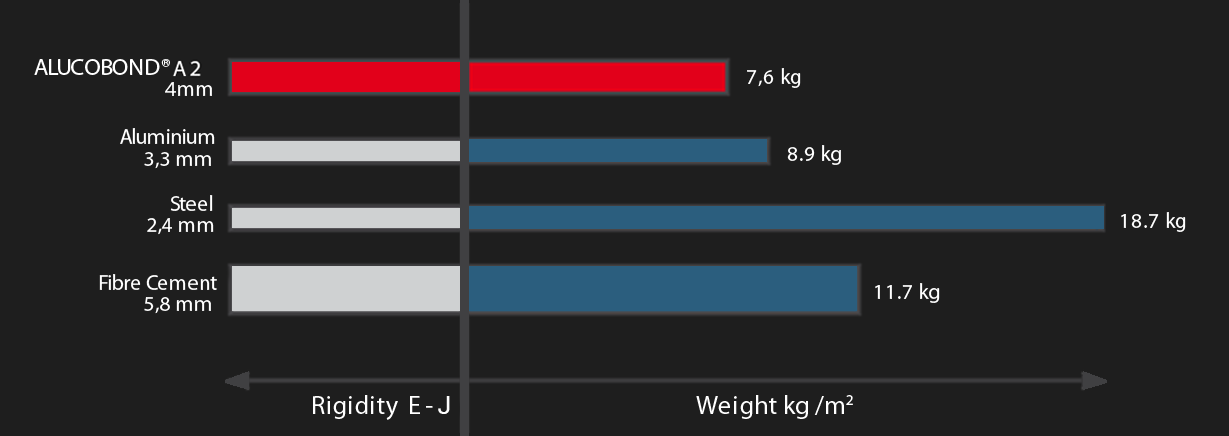
The composite structure of ALUCOBOND® A2 means it has an impressive strength to weight ratio, no matter if it is a large panel size. Despite its low weight – which makes ALUCOBOND® A2 easy to transport and handle – its rigidity helps maintain its shape and flatness, even when exposed to extreme temperature changes.
Comparison of thickness and weight of panels with equal rigidity
| ALUCOBOND® PLUS | Aluminium | ||||
| Rigidity (E·J) | Section modulus | Thickness | Weight | Thickness | Weight |
| 1250 kN cm²/m | 1.25 cm³/m | 3 mm | 5.9 kg/m² | 2.7 mm | 7.3 kg/m² |
| 2400 kN cm²/m | 1.75 cm³/m | 4 mm | 7.6 kg/m² | 3.3 mm | 8.9 kg/m² |
Sustainability
3A Composites: Environment, Safety, and Quality
3A Composites is the parent company of ALUCOBOND® and is recognized across the globe as one of the leaders in the field of sustainability. Its reputation is spread far and wide, including among other diversified producers and raw material processing companies around the world.
The company’s unflinching commitment to sustainability – along with taking the needs of all key groups into account – enables it to make decisions of the highest economic, social, and ecological value. 3A Composites also commits to continuous self-improvement programs for environmental protection, many of which exceed government regulations.
ALUCOBOND® A2 Lifecycle
Over decades of use in a rear-ventilated cladding system, ALUCOBOND® A2 protects a building from weathering and the harmful effects of industrial and environmental pollution. It also acts as a barrier against solar radiation; the ventilated space between the ALUCOBOND® A2 panels and the wall or the thermal insulation reduces heat transmission.
ALUCOBOND® A2 also protects the wall of a building from high and rapid temperature changes; moisture can pass through the wall, yet the building structure remains dry.
During the lifecycle of ALUCOBOND® A2 composite panels, no substances containing CFC are set free at any time. The core material does not contain any nitrogen, chlorine, or sulfur – therefore, it is the perfect choice for projects which require environmental-friendly materials.
[/vc_column_text][vc_row_inner content_placement=”middle” css=”.vc_custom_1704355174529{padding-top: 30px !important;}”][vc_column_inner width=”1/6″][vc_single_image image=”5701″ img_size=”large”][/vc_column_inner][vc_column_inner width=”5/6″][vc_column_text]
The major advantages
- Lower maintenance costs
- Long-term preservation of the building’s structure
- During winter there are major savings in heating costs
- In summer there are major savings in air-conditioning costs
- Reduction of thermal expansion
- Reduction in crack formation
[/vc_column_text][/vc_column_inner][/vc_row_inner][vc_column_text css=”.vc_custom_1704355280597{padding-top: 30px !important;}”]
Recycling
ALUCOBOND® A2 is fully recyclable. Both the core material and the aluminium cover sheets can be used in the production of new material.[/vc_column_text][/edgtf_accordion_tab][edgtf_accordion_tab title=”Product Range”][vc_column_text]
| ALUCOBOND® A2 | Thickness: 3/4mm |
|---|
| Width (mm) | 1000 | 1250 | 1500 | 1575 | 1650 |
|---|---|---|---|---|---|
| Length (mm) | 2500-6999 | 2500-6999 | 2500-6999 | 2500-6999 | 2500-6999 |
| Solid Colours |  |
|
 |
||
| Metallic Colours | |
|
|
||
| Spectra & Sparkling | |
||||
| ALUCOBOND® Anodized Look | |
|
|
||
| ALUCOBOND® Natural* | |
|
|||
| ALUCOBOND® Legno – Premium Wood | |
|
|||
| ALUCOBOND® Vintage | |
|
|||
| ALUCOBOND® Façade design | |
|
|||
| ALUCOBOND® Urban | |
|
|||
| ALUCOBOND® Terra | |
|
|||
| ALUCOBOND® Rocca | |
|
|||
| ALUCOBOND® Design | |
|
Footnotes:
on request
Dimensional Tolerances
[/vc_column_text][vc_row_inner][vc_column_inner width=”1/2″][vc_column_text]Due to manufacturing, a displacement of the cover sheets sidewise at the panel edges up to 2 mm is possible.
Thickness: ± 0,2 mm
(mill-finish | stove lacquered | anodized)
Width: – 0 / + 4 mm
Lengths: 2500 – 400 mm; – 0 / + 6
Lengths: 4001– 6999 mm; – 0 / + 10 mm[/vc_column_text][/vc_column_inner][vc_column_inner width=”1/2″][vc_column_text]* Anodized according to DIN 17611. All anodized ALUCOBOND® composite panels have contact lines (about 25 mm width) on their short sides. For panel lengths of more than 3500 mm, the composite panels have contact lines (about 2 – 3 mm width) on their long sides. Maximum panel length 6999 mm. Please take this into consideration when dimensioning the panels.[/vc_column_text][/vc_column_inner][/vc_row_inner][/edgtf_accordion_tab][edgtf_accordion_tab title=”Technical Data”][vc_column_text]
| THICKNESS | STANDARDS | UNIT | 3MM | 4MM | |
|---|---|---|---|---|---|
| Thickness of Aluminium Layers | [mm] | 0.5 | 0.5 | ||
| Weight | [kg/m²] | 5.9 | 7.6 | ||
| Width | [mm] | 1250 / 1500 | 1250 / 1500 |
| TECHNICAL PROPERTIES | STANDARDS | UNIT | 3MM | 4MM | |
|---|---|---|---|---|---|
| Section modulus | W | DIN 53293 | [cm³/m] | 1.25 | 1.75 |
| Rigidity | E·J | DIN 53293 | [kNcm²/m] | 1250 | 2400 |
| Alloy / Temper of Aluminium Layers | EN 573-3 / EN 515 | EN AW 5005A (AIMg1) H22/H42 | EN AW 5005A (AIMg1) H22/H42 | ||
| Modulus of Elasticity | EN 1999 1-1 | [N/mm²] | 70.000 | 70.000 | |
| Tensile Strength of Aluminium | EN 485-2 | [N/mm²] | Rm ≥ 130 | Rm ≥ 130 | |
| 0.2 % Proof Stress | EN 485-2 | [N/mm²] | Rp0,2 ≥ 90 | Rp0,2 ≥ 90 | |
| Elongation | EN 485-2 | [%] | A50 ≥ 5 | A50 ≥ 5 | |
| Linear Thermal Expansion | EN 1999 1-1 | 2.4 mm/m at 100ºC temperature difference | 2.4 mm/m at 100ºC temperature difference |
| CORE | STANDARDS | UNIT | 3MM | 4MM | |
|---|---|---|---|---|---|
| Mineral compound, polymer bonded |
| SURFACE | STANDARDS | UNIT | 3MM | 4MM | |
|---|---|---|---|---|---|
| Lacquering | Coil Coating Fluorocarbon based (e.g. PVDF) | Coil Coating Fluorocarbon based (e.g. PVDF) | |||
| Gloss (initial value) | EN 13523-2 | [%] | 30-80 | 30-80 | |
| Pencil Hardness | EN 13523-4 | HB-F | HB-F |
| ACOUSTICAL PROPERTIES | STANDARDS | UNIT | 3MM | 4MM | |
|---|---|---|---|---|---|
| Sound Absorption Factor | αs | ISO 354 | 0.5 | 0.5 | |
| Sound Transmission Loss | Rw | ISO/DIS 717-1, EN ISO 140-3 | [dB] | 27 | 27 |
| Loss Factor | d | EN ISO 6721 Frequency range 100-3200 Hz | 0.004 | 0.005 |
| THERMAL | STANDARDS | UNIT | 3MM | 4MM | |
|---|---|---|---|---|---|
| Thermal Resistance | R | DIN 52612 | [m²K/W] | 0.002 | 0.002 |
| Thermal conductivity | λ | DIN 52612 | [W/mK] | 1.99 | 1.77 |
| Heat Transition Coefficient | U | DIN 52612 | [W/m²K] | 5.83 | 5.80 |
| Temperature Resistance | [ºC] | -50 to +80 | -50 to +80 |
[/vc_column_text][vc_column_text css=”.vc_custom_1712216189163{padding-bottom: 15px !important;}”]
Wind load and permissible panel sizes
[/vc_column_text][vc_row_inner][vc_column_inner width=”1/2″][vc_column_text css=”.vc_custom_1712216258912{padding-bottom: 15px !important;}”]
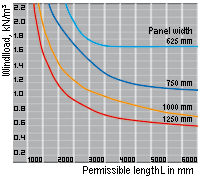
ALUCOBOND® A2 3 mm
[/vc_column_text][/vc_column_inner][vc_column_inner width=”1/2″][vc_column_text css=”.vc_custom_1712216265455{padding-bottom: 15px !important;}”]
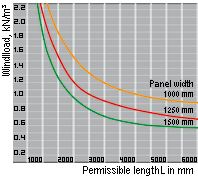
ALUCOBOND® A2 4 mm
[/vc_column_text][/vc_column_inner][/vc_row_inner][vc_column_text]The graphs for 3 mm and 4 mm thick ALUCOBOND® A2 indicate the maximum permissible panel length (σ = 53 N/mm²) (without having to add a stiffener) based in applicable design wind load and panel width. Values apply to 4-side supported panels. Values for other systems on request.[/vc_column_text][/edgtf_accordion_tab][edgtf_accordion_tab title=”Processing”][vc_tta_accordion style=”flat” shape=”square” color=”black” spacing=”5″ c_icon=”chevron” c_position=”right” active_section=”4000″ no_fill=”true” collapsible_all=”true” css=”.vc_custom_1704359259019{background-color: #1e1e1e !important;}”][vc_tta_section title=”Cutting” tab_id=”Cutting-alucobond-a2″][vc_column_text]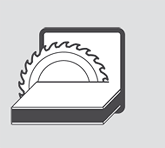 ALUCOBOND® A2 can be cut with a vertical panel saw, circular saw, or jigsaw. Carbide tipped (CT) saw blades.
| Blade geometry | Tooth thickness approx. 2 – 4 mm, tapered to the inside to prevent jamming |
| Tooth geometry | Trapezoid tooth / flat tooth |
| Pitch t | 10 – 12 mm |
| Clearance angle α | 15° |
| Rake angle γ | 10° positive |
| Maximum feed s | 20 m/min |
Important: For ALUCOBOND® A2 special carbide tipped (CT – quality K01) saw blades are used. The speed must be reduced by 50%. Carbide tipped (CT) saw blades can be used for HOLZ-HER and Striebig circular panel saws. Trapezoid/flat tooth saw blade, flat teeth 45° chamfered can be used for burr-free edges.
| Saw blade-Ø | D = 300 mm (for Striebig vertical panel saw Standard II) |
| Number of teeth | t = 72 Speiser Code No. 070 60 651 |
| Saw blade-Ø | D = 250 mm (for Holz-Her vertical panel saw 1255 ALUCOBOND®) |
| Number of teeth | t = 60 (for cuts of up to 5 panels) Speiser Code No. 020 40 151 |
| Bore Ø | D = 30 mm |
| Tooth thickness | 3.2 mm |
| Clearance angle α | 15° |
| Rake angle γ | 10 ° positive |
[/vc_column_text][/vc_tta_section][vc_tta_section title=”Punching” tab_id=”Punching-alucobond-a2″][vc_column_text]
ALUCOBOND® A2 panels of any thickness can be punched using conventional sheet punching machines.
- For clean cuts use sharp tools and dies with minimal cutting clearance (0.1mm). Punching will cause a slight deflection at the cut edge of the impact side.
- Holes with a minimum diameter of 4mm can be punched.
- Distance between the adjacent hole edges should not be less than 4mm
- Please ask for detailed information on how to perforate ALUCOBOND® A2 before proceeding.
[/vc_column_text][/vc_tta_section][vc_tta_section title=”Contour Cutting” tab_id=”contour-cutting-alucobond-a2″][vc_column_text]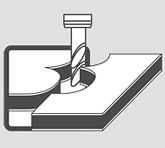
ALUCOBOND® A2 can be cut to shape using a jigsaw, CNC machine and waterjet machine.
- While using a jigsaw, use saw blades that are used for cutting wood and plastic material.
- Cut abrasively while using a waterjet cutting machine. Pre-drilling of panels is required before commencing.
- While using a waterjet, a cut is needed in the middle of the panel as it is not possible to drill through using a waterjet.
- CNC machining centres should use one-edged cutter.
- CNC machining centres should use a one-edged cutter.
[/vc_column_text][/vc_tta_section][vc_tta_section title=”Bending” tab_id=”Bending-alucobond-a2″][vc_column_text]
ALUCOBOND® A2 can be bended using bending press.
- The minimum required radius is r = 25 x t (t = panel thickness)
- The spring-back effect of ALUCOBOND®A2 is greater than that of a solid aluminium sheet.
- The die edges should be rounded and smooth.
- To prevent damage to the panel surface, the protective foil must not be removed during bending.
- Additionally, the visible surface can be protected by using plastic pads of 1-2mm thickness
- Ideal die width: 2 x t + 2 x protective foil thickness + punch diameter + 15mm
- Before scaled-up production, testing on the sample panels is recommended.

A = punch
B = protective foil
C = die
D = die width
r = radius[/vc_column_text][/vc_tta_section][vc_tta_section title=”Roll Bending” tab_id=”roll-bending-alucobond-a2″][vc_column_text]

ALUCOBOND® A2 can be bent using a roll bending machine (3 or 4 rollers). Make sure that the feeder does not exert too much pressure. Bending rollers which are also used for bending other metals must be thoroughly cleaned from swarf before processing ALUCOBOND® A2.
Make sure to use only polished rollers free of dents and other defects. To prevent damage caused to the panel surface, the protective peel-off foil must not be removed during bending. Additionally, the visible surface can be protected by using plastic pads of 1–2mm thickness. Before scaled-up production, testing on the sample panels is recommended.
[/vc_column_text][/vc_tta_section][vc_tta_section title=”Routing & Folding” tab_id=”Routing-Folding-alucobond-a2″][vc_single_image image=”6389″ img_size=”full” alignment=”center” css=”.vc_custom_1704360418849{padding-bottom: 2em !important;}”][vc_row_inner][vc_column_inner width=”3/4″][vc_column_text]
[/vc_column_text][/vc_column_inner][vc_column_inner width=”1/4″ css=”.vc_custom_1712216787000{padding-top: 10px !important;}”][vc_single_image image=”5709″ img_size=”full”][/vc_column_inner][vc_column_inner][vc_column_text]
Advantages
The convincing advantages of this unique technique are:
- Low investment cost
- Simple fabrication technique
- Folding can be done on site, saving transportation cost
- Low-cost fabrication of shaped components used in fascia and wall cladding, roof edgings, column cladding, flashings, etc.
- Flexibility in creating shapes
- Very economical
- Shapes are not limited by machine capacity
Benefits
- The fabrication of shaped components using ALUCOBOND®A2 only requires a minimal investment outlay.
- Hand routers and sheet milling machines are inexpensive and can be used either in the workshop or on site.
- The fabrication of shapes in larger quantities is particularly economical using vertical panel saws equipped with ALUCOBOND®A2 grooving accessories.
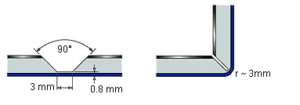
90° V-groove for folds up to 90°
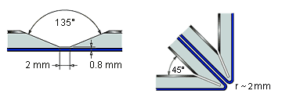
135° V-groove for folds up to 135°
[/vc_column_text][/vc_column_inner][/vc_row_inner][/vc_tta_section][vc_tta_section title=”Riveting” tab_id=”Riveting-alucobond-a2″][vc_column_text]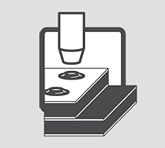
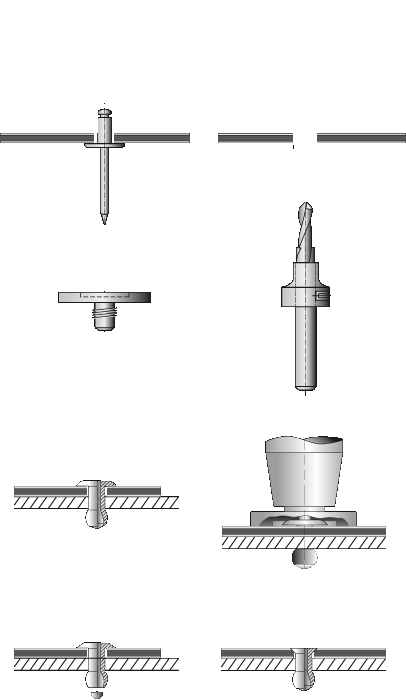
Riveting is possible using solid or blind rivets with conventional riveting tools. For exterior applications allow for thermal expansion and use a rivet attachment jig if necessary. ALUCOBOND® A2 panels can be fastened together or joined to other materials using rivets commonly used in aluminium construction. For outdoor use and for use in areas of high humidity, make sure to use aluminium blind rivets with stainless steel mandrels to prevent unpleasant corrosive edges. When using aluminium blind rivets with steel mandrels, the mandrel should drop out after riveting (detachable version). Countersunk rivets are suitable for indoor use only.
For outdoor use please note:
- Use aluminium blind rivets that have been approved for construction with a 5mm shaft diameter and an attachment head diameter of 11mm or 14mm.
- Take the thermal expansion of the panel into account (2.4mm/m/100°C). To avoid jamming, the hole in the panel must be large enough to allow for expansion.
- With the shaft of the rivet fitting closely to the edge of the hole, the attachment head must cover 1mm of the area surrounding the hole.
- Multi-step drills or sleeves having corresponding diameters are used for centrically drilling holes into the panel and the substructure for centrically fitting the rivet.
- Rivet attachment jigs are used for fitting blind rivets without jamming, allowing for a tolerance of 0.3mm.
- Make sure to use rivet attachment jigs and rivets from the same manufacturer, as the height of the attachment head according to DIN 7337 may vary.
- The clamping thickness results from the thickness of the material to be riveted plus an additional value of 2mm to ensure that the closing head is perfectly formed. In accordance with this clamping thickness, the corresponding shaft length is determined in the tables provided by the rivet manufacturers. (Lmin = 14mm).
Important: During riveting many factors influence exact tolerance of the rivets of 0.3 mm (e.g. rivet head tolerance). We recommend testing on the fascia panels before commencing. Always remove the protective foil from the riveting surface area before riveting.
 [/vc_column_text][/vc_tta_section][vc_tta_section title=”Screwing” tab_id=”Screwing-alucobond-a2″][vc_column_text]
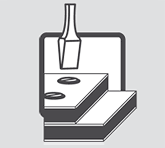
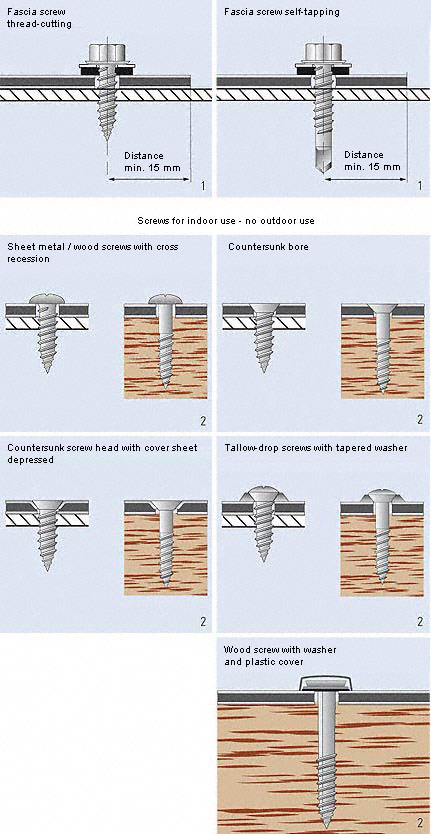
Threaded fasteners for outdoor use
Threaded fasteners for indoor use
 [/vc_column_text][/vc_tta_section][/vc_tta_accordion][/edgtf_accordion_tab][edgtf_accordion_tab title=”Fixing Systems”][vc_row_inner][vc_column_inner width=”1/3″ css=”.vc_custom_1712221874915{padding-bottom: 40px !important;}”][edgtf_image_with_text enable_image_shadow=”no” image_behavior=”lightbox” title_tag=”” image=”6396″ image_size=”150×150″ title=”Tray panels suspended” title_color=”#ff9125″ title_top_margin=”10″ text=”on stainless steel bolts / vertical panel layout” text_color=”#ffffff”][/vc_column_inner][vc_column_inner width=”1/3″ css=”.vc_custom_1712221883163{padding-bottom: 40px !important;}”][edgtf_image_with_text enable_image_shadow=”no” image_behavior=”lightbox” title_tag=”” image=”6427″ image_size=”150×150″ title=”Tray panel screwed” title_color=”#ff9125″ title_top_margin=”10″ text=”for vertical panel layout” text_color=”#ffffff”][/vc_column_inner][vc_column_inner width=”1/3″ css=”.vc_custom_1712221888676{padding-bottom: 40px !important;}”][edgtf_image_with_text enable_image_shadow=”no” image_behavior=”lightbox” title_tag=”” image=”6398″ image_size=”150×150″ title=”Tray panels SZ-20″ title_color=”#ff9125″ title_top_margin=”10″ text=”tongue and groove design / horizontal panel layout” text_color=”#ffffff”][/vc_column_inner][/vc_row_inner][vc_row_inner][vc_column_inner width=”1/3″ css=”.vc_custom_1712221895853{padding-bottom: 40px !important;}”][edgtf_image_with_text enable_image_shadow=”no” image_behavior=”lightbox” title_tag=”” image=”6399″ image_size=”150×150″ title=”Glued” title_color=”#ff9125″ title_top_margin=”10″ text=”for vertical / horizontal panel layout” text_color=”#ffffff”][/vc_column_inner][vc_column_inner width=”1/3″ css=”.vc_custom_1712221905603{padding-bottom: 40px !important;}”][edgtf_image_with_text enable_image_shadow=”no” image_behavior=”lightbox” title_tag=”” image=”6400″ image_size=”150×150″ title=”Tray panel screwed” title_color=”#ff9125″ title_top_margin=”10″ text=”on omega carrier section for vertical panel layout” text_color=”#ffffff”][/vc_column_inner][vc_column_inner width=”1/3″ css=”.vc_custom_1712221912043{padding-bottom: 40px !important;}”][edgtf_image_with_text enable_image_shadow=”no” image_behavior=”lightbox” title_tag=”” image=”6401″ image_size=”150×150″ title=”Riveted / screwed” title_color=”#ff9125″ title_top_margin=”10″ text=”on vertical profiles for vertical panel layout” text_color=”#ffffff”][/vc_column_inner][/vc_row_inner][vc_row_inner][vc_column_inner width=”1/3″ css=”.vc_custom_1712221917210{padding-bottom: 40px !important;}”][edgtf_image_with_text enable_image_shadow=”no” image_behavior=”lightbox” title_tag=”” image=”6402″ image_size=”150×150″ title=”Clamped / screwed” title_color=”#ff9125″ title_top_margin=”10″ text=”double “top-hat”sections” text_color=”#ffffff”][/vc_column_inner][vc_column_inner width=”1/3″ css=”.vc_custom_1712221921890{padding-bottom: 40px !important;}”][edgtf_image_with_text enable_image_shadow=”no” image_behavior=”lightbox” title_tag=”” image=”6403″ image_size=”150×150″ title=”Riveted weather boarding” title_color=”#ff9125″ title_top_margin=”10″ text=”on aluminium substructure” text_color=”#ffffff”][/vc_column_inner][/vc_row_inner][/edgtf_accordion_tab][edgtf_accordion_tab title=”Fire Classification”][vc_column_text]
| Country | Test accord.to | Classification |
|---|---|---|
| Australia | AS ISO 9705
AS 1530.3 Indices
EN 13501-1 |
Group 1 material
SMOGR A 0.630 m2 / s2 0 (ignitibility) 0 (flame spread) 0 (heat evolved) 0-1 (smoke development) A2-s1, d0 |
| China | GB 8624-2012 | Class A (A2- s1,d0, t0) |
| EU | EN 13501-1 | Class A2-s1, d0 |
| Germany | EN 1187 (method 1) /
DIN 4102-7 |
Passed |
| Great Britain
England / Wales / Scotland |
BR 135
BS 8414 part 1 & 2 |
met the performance criteria
Passed |
| Malaysia | BS 8414-1
BS 476, Part 6 BS 476, Part 7 Approved for outdoor wall cladding of any type of building without height limit |
Passed
Class 0 Class 1 |
| Poland | EN 13501-1
BS 476, Part 6&7 (Core Exposed) NFPA 285 Approved for outdoor wall cladding of any type of building without height limit |
Class A2-s1, d0 |
| Russia | GOST 30244-94
GOST 30402-95 GOST 12.1.044-89 GOST 12.1.044-89 |
G1 (combustibility)
W1 (flammability) D1 (smoke development) T1 (toxicity) |
| Singapore | EN 13501-1 BS 476, Part 6&7 (Core Exposed) NFPA 285 Approved for outdoor wall cladding of any type of building without height limit |
Class A2, s1, d0 Passed Passed |
| Switzerland | VKF | RF1 |
| UAE | NFPA 285 EN 13501-1 ASTM E84 |
Passed Class A2-s1, d0 Class A |
[/vc_column_text][/edgtf_accordion_tab][edgtf_accordion_tab title=”Installation | Maintenance | Storage | Handling Guideline”][vc_row_inner css=”.vc_custom_1704360498380{padding-bottom: 2em !important;}”][vc_column_inner width=”1/2″ css=”.vc_custom_1712222356296{padding-bottom: 20px !important;}”][vc_single_image image=”5727″ img_size=”medium” onclick=”link_image”][/vc_column_inner][vc_column_inner width=”1/2″ css=”.vc_custom_1712222362095{padding-bottom: 20px !important;}”][vc_single_image image=”5728″ img_size=”medium” onclick=”link_image”][/vc_column_inner][/vc_row_inner][vc_column_text]
To avoid possible reflection differences (for metallic, special effect, naturAL, and spectra colours), it is recommended to install the panels in the same direction as marked on the protective peel-off-foil. Colour variations may occur between panels originating from different production batches. To ensure colour consistency, the total requirement for a project should be placed in one order.
| Dimensional tolerances | ||
|---|---|---|
| Thickness | ±0.2 mm | |
| Width | -0 / +6 mm | |
| Lengths | 1000 – 4000 mm | -0 / +6 mm |
| Lengths | 4001 – 8000 mm | -0 / +10 mm |
Due to the production process, a displacement of the cover sheets of max. 2 mm to one side may occur along the longer sides of the panels if not specially trimmed.
Protective foil
- To avoid residuals of glue sticking to the surface of the panels due to UV radiation, it is recommended to remove the protective foil as soon as possible after the installation.
- The protective foils and the panel surfaces must not be marked using ink (marker), adhesive tapes or stickers, as the lacquered surfaces could be damaged by solvents or plasticizers.
- Make sure to remove the protective foil as soon as possible after installation as weathering for a longer period could make the foil difficult to remove.
Cleaning and maintenance
The frequency of cleaning depends on the design and the degree of soiling. For further information, please refer to our brochure.
[/vc_column_text][vc_row_inner content_placement=”bottom”][vc_column_inner width=”1/12″][vc_single_image image=”7682″][/vc_column_inner][vc_column_inner width=”11/12″][vc_column_text]
ALUCOBOND®
Download our Alucobond processing manual
 PDF [4.23 MB].[/vc_column_text][/vc_column_inner][/vc_row_inner][vc_column_text]
STORAGE / HANDLING
- Protect ALUCOBOND® A2 pallets during storage against rain, penetration of moisture and condensation.
- Only pallets of identical size should be stacked, with a maximum of 6 pallets stacked on top of each other.
- Storage exceeding 6 months should be avoided, as it may become difficult to remove the protective foil.
- When stacking the panels nothing should be placed in between them, as this could produce marks on the panels.
RECYCLING
ALUCOBOND® A2 can be fully recycled, i.e. both the core material and the aluminium cover sheets can be recycled and used for the production of new material.[/vc_column_text][/edgtf_accordion_tab][/edgtf_accordion][/vc_column][/vc_row]